Young scientists, inventors and mathematicians score big
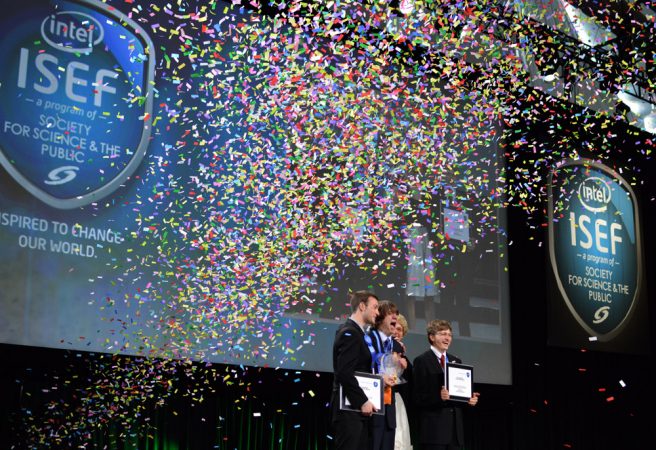
PITTSBURGH— IT took nerves of steel—and a great science project—to survive a week of judging here in Steel Metropolis.
When all was said and through with, three students at this yr's Intel International Scientific discipline and Engineering Fair walked away with prizes Charles Frederick Worth leastways $50,000. Those prizes were just a divide of the awards valued at more than $3 jillio and given for projects that formed a new case of exam for pancreatic cancer, a more efficient way to search through short documents so much as tweets and a process that could boost data storage rates in devices using quantum memory.

Intel ISEF, a curriculum of Society for Science & the Public (Scientific discipline News for Kids' parent organization), attracts whatsoever of the world's best and brightest young scientists. This year, 1,549 high-school students participated in the event. They represented 446 associate science fairs in 68 countries, regions and territories.
In all, much one-third of the entrants received cash awards Beaver State other prizes at a May 18 ceremony. The first- done fourth- place winners in each of 17 categories received cash awards ranging from $500 to $5,000. Different prizes ranged from scholarships and medals to nonrecreational summer internships.
A petty more 1,000 of the participants in this annual scientific discipline competition presented unaccompanied research. The remainder were split of two- or three-pupil teams. Roughly 1 out of all 3 competitors came from outside the United States and its territories.
"We sponsor the Intel International Science and Engineering Funfair to boost millions of young innovators around the world to propel their curiosity into action," said Wendy Sir John Hawkyns, executive theatre director of the Intel Introduction, which sponsors the competition. "The finalists assembly in Pittsburgh throw the potential to contribute to solving some of the world's most pressing issues."
This year's top pry, the $75,000 Gordon E. Dudley Moore award (named for the Intel conscientious objector-founder), went to Jack Andraka of Crownsville, Md. For his project, he drenched small strips of paper with a solution of tiny tubes of carbon (called nanotubes) and with antibodies (part of the imperfect condition system that help crusade disease) that oppose with a specific lifelike chemical associated of duct gland Cancer. These examine strips provide results in 5 transactions and cost about three cents all. Currently, the standard run for diagnosing pancreatic cancer takes 14 hours and costs about $800, says Andraka.
Andraka has practical for a patent on his ontogeny. And he's by no means alone in doing so, notes Elizabeth I Marincola, president of Society for Scientific discipline &adenosine monophosphate; the Unexclusive. About one-fourth of his fellow Intel ISEF entrants either hold patents on their research or have applied for them, she says. Increasingly, she notes, students "are looking to educate their ideas, not just to have them."
Two young researchers — Nicholas Schiefer of Pickering, Canada, and Ari Dyckovsky of Leesburg, Va. — received Intel Foundation Young Scientist Awards worthy $50,000.
Schiefer developed a computer algorithm that more efficiently searches through short strings of text. These might be tweets (which are limited to 140 characters or to a lesser extent), Facebook position updates Oregon news headlines. To boost the search efficiency, a mathematical normal he highly-developed allows computers to scan the textbook, looking not only for specific keywords but also for intimately related terms. For example, a hunt for the word "earthquake" would also scan the documents for terms much as quake, temblor, and shock.
Dyckovsky's project focused connected using quantum dots — billionth-of-a-meter-scale particles made from silicon or other solid-state materials — to store information. He developed a proficiency that can advance the speed at which computers can fund information in memory. While current methods typically allow quantum devices to stash awa bits of data only once all several minutes, the new technique could boost that rate to erstwhile every hardly a seconds, he suggests.
Topical awards
Seventeen students won "best of category" awards, each worth $5,000. Andraka's project as wel claimed one of these awards — in the medicine and health sciences category; Schiefer did the cookie-cutter in the computing chemical group, and Dyckovsky came in prototypal among the entrants in physics and uranology.
In animal sciences, Lucy Hritzo of Holland, Pa., won for her analyses of Borrelia burgdorferi, This bacterium, transmitted by ticks, causes Lyme disease. She known a genetic difference 'tween bacteria in the bloodstream of humans who had become infected and those that had crossed the questionable blood-brain barrier. The finding points to a possible object for treatment to alleviate or prevent some of the disease's devastating nerve symptoms.
Analyses of how relationships between parents and children influence an jejune's likelihood to engage in risky behaviors won Benzoin Kornick of Roslyn Heights,N.Y., the cover prize in the behavioral and social sciences category. Atomic number 2 found that certain aspects of parent-child interactions can influence a teen's behavior both online (such as a willingness to share personal information) and offline (such as engaging in sexual natural action or drug use). For exemplify, He found that when parents often asked their teens about a particular unsafe behavior, kids were much more likely to engage in that behavior — possibly because they consider the activity to be "forbidden fruit" and hence desirable, says Kornick.
How cistron mutations touch the efficiency by which chemicals pass through the satellite membranes of cells won Rebecca Alford of Commack, N.Y., the top appreciate for biochemistry. And Adam Noble of Lakefield, Canada, won first prize in environmental sciences for developing a proficiency to remove nanosilver pollution from waste water (for more on his work, hindrance out this).
Enquiry happening interactions between two abnormal proteins in the brain of Alzheimer's patients landed Raghav Tripathi of Portland,Ore., the elevation loot in cellular and molecular biology. He performed science lab tests together with computer analyses of the proteins. His findings turned up imaginable targets for drugs that might lentissimo the progression of dementia, a trademark of the disease.
Naomi Shah of Portland,Ore., won top prize in the environmental science family for her tests showing that soil bacteria could be accustomed damp down certain interior melodic phrase pollutants commonly emitted by paints, carpets and other building materials. She created a device that holds the microbes — what she calls a biofilter. If installed in a central heating and air conditioning system, IT could help remove toxic chemicals circulating in a home's air.
Felix Angelov of Skokie, Ill., took plate the top microbiology prize for identifying how interfering with material signaling between fated types of bacteria might help prevent disease. He worked with bacteria that are a close — but nonmalignant — relative of the germs that have cholera. He found a way to stoppage the bacteria from recognizing a chemical initiation that causes real cholera germs to give up their poisons. (Cholera is an infectious disease affecting the small gut. It causes potentially deadly bouts of diarrhea.)
Huihui Fan of Staten Island, N.Y., identified a factor that influences base growth in Arabidopsis thaliana, a weedy plant ofttimes considered "the science laborator rat of agriculture." Away manipulating this gene, operating theatre by selecting plants that course produce certain variants of that gene, researchers may one day prepare plants operating room crops that tolerate drought, better prevent soil erosion or Thomas More efficaciously soak up pollutants from soil. The finding won Fan the top award in flora sciences.
Raghavendra Ramachanderan of Bengaluru,India, highly-developed deuce-ac types of catalysts — substances that trigger or speed up chemical reactions (without undergoing any changes themselves). These new catalysts absorb vigour from circumpolar light and then pitch it to chemicals. Those chemicals then undergo reactions to restore partially cooked fuel. This parvenue process could find use in everything from industrial processes to energy storage devices so much Eastern Samoa batteries — and won Ramachanderan the clear award in interpersonal chemistry.
The first place prize in earth science went to research analyzing possible personal effects of a proposed canal between the Red Sea and the Dead Sea. Water engineers have been considering the exploitation of this canal to raise pee level in the Dead Sea(which has been dropping in recent decades) and to decrease saltiness in the water there. Mofeed Wael Sawan of Capital of the United Kingdom, Canada, found that besides these intended effects, the added water — and certain types of bacteria that would hitch a sit in it — could significantly alter the ecosystem of the Dead Sea, which may not embody a good affair. In addition, the canal may change how liquified minerals in the water drop out of solution to form sediments. Because scientists hadn't previously considered this switch, whether its effects might be good enough or bad is an clear question.
In the energy and transportation category, Shyamal Buch of Folsom,Calif., won for his study of techniques to improve the industry of star cells. His proposed changes to the nano-exfoliation structure of the materials used to make these cells might also improve their power-generating efficiency. In mathematics, Aishwarya Vardhana of Beaverton,Ore., highly-developed a technique to more than quickly break large Book of Numbers into the smaller ones that were increased together to have the big act. This advance could help break certain types of codes much quickly (but, thankfully, also enhances the ability to make grow stronger codes of another type).
The design for a wind turbine that could operate fairly efficiently at short speeds garnered Assiya Kussainova of Karagandy,Kazakh, premier place in electrical and mechanical engineering. Most wind turbines don't sire power expeditiously at wind speeds down the stairs 10 meters per second (and terminate't operate at all when wind speeds drop below 5 m/s), the young woman explains. But substituting long, rotating cylinders for the more-aerodynamic blades found on most basic wander turbines could enable the turbines to generate power at wind speeds as low arsenic 3 m/s, her work indicates.
Ryota Ishizuka of Cos lettuce Cob,Conn., won first place in materials science and biotechnology, for developing an electronic struggle that might be used happening robots. The other rind includes thin-cinema sensors as advantageously arsenic flexible circuits and star cells. Such a skin might allow a robot that is sent into a dangerous area to sense, take hold of, and retrieve objects; operating room to touch them and detect biochemical agents.
Move on awards too
In addition to their "superior of category" awards, Fan, Noble and Ramachanderan received the Dudley R. Herschbach Stockholm International Youth Scientific discipline Seminar award. It includes an all-expenses-paid travel to the seminar in Sweden and to the Nobel Prize ceremonies in Capital of Sweden.
Kussainova, Shah and Tripathi likewise won complete-disbursement-paid trips — in their cases to attend the European Union Contest for Young Scientists. This class, the competition takes set up in the capital ofSlovakia—Bratislava— during September.
Eastern Samoa the projects represented here illustrate, "the Intel International Skill and Engineering Fair provides an chance for the best young scientists from round the ball to contribution ideas and case their edged-edge science projects," says Marincola. "By inspiring and satisfying young scientists, this political platform, now in its 63rd year, will help the next propagation usher in new solutions to global challenges, which are vital to our common future."

Enregistrer un commentaire for "Young scientists, inventors and mathematicians score big"