Airline Disaster Crash of the Century Movie Review
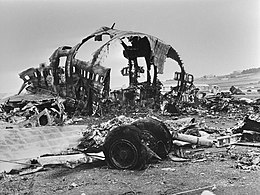 Wreckage of the KLM aircraft on the rails at Los Rodeos | |
| Accident | |
|---|---|
| Date | March 27, 1977 |
| Summary | Runway standoff in fog |
| Site | Los Rodeos Airdrome Coordinates: 28°28′54″N 16°20′eighteen″West / 28.48165°N 16.3384°Westward / 28.48165; -16.3384 |
| Total fatalities | 583 |
| Full injuries | 61 |
| Total survivors | 61 |
| First aircraft | |
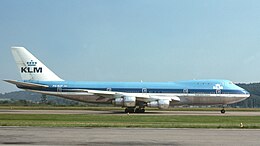 PH-BUF, the KLM Boeing 747-206B involved in the accident | |
| Blazon | Boeing 747-206B |
| Name | Rijn ("Rhine") |
| Operator | KLM Majestic Dutch Airlines |
| IATA flying No. | KL4805 |
| ICAO flight No. | KLM4805 |
| Call sign | KLM 4805 |
| Registration | PH-BUF |
| Flight origin | Schiphol Airport Amsterdam, Netherlands |
| Destination | Gran Canaria Airport Gran Canaria, Canary Islands |
| Occupants | 248 |
| Passengers | 234 |
| Crew | 14 |
| Fatalities | 248 |
| Survivors | 0 |
| Second aircraft | |
 N736PA, the Pan Am Boeing 747-121 involved in the accident in April, 1972 | |
| Type | Boeing 747-121 |
| Proper name | Clipper Victor |
| Operator | Pan American Earth Airways |
| IATA flight No. | PA1736 |
| ICAO flight No. | PAA1736 |
| Call sign | CLIPPER 1736 |
| Registration | N736PA |
| Flight origin | Los Angeles International Airport Los Angeles, Usa |
| Stopover | John F. Kennedy International Aerodrome, New York Urban center, U.S. |
| Destination | Gran Canaria Aerodrome Gran Canaria, Canary Islands |
| Occupants | 396 |
| Passengers | 380 |
| Crew | 16 |
| Fatalities | 335 |
| Injuries | 61 |
| Survivors | 61 |
The Tenerife airport disaster occurred on March 27, 1977, when 2 Boeing 747 passenger jets collided on the rail at Los Rodeos Airport[1] on the Spanish island of Tenerife.[2] [3] The collision occurred when KLM Flight 4805 initiated its takeoff run while Pan Am Flight 1736 was still on the runway. The impact and resulting fire killed everyone on board KLM 4805 and most of the occupants of Pan Am 1736, with only 61 survivors in the forepart section of the shipping.[2] [3] Resulting in 583 fatalities, the disaster is the deadliest accident in aviation history.
A terrorist incident at Gran Canaria Drome had acquired many flights to exist diverted to Los Rodeos, including the ii shipping involved in the accident. The drome apace became congested with parked airplanes blocking the only taxiway and forcing departing aircraft to taxi on the rails instead. Patches of thick fog were drifting beyond the airfield; hence visibility was greatly reduced for pilots and the control tower.[2] [3]
The subsequent investigation by Castilian authorities concluded that the master crusade of the accident was the KLM captain'southward conclusion to take off in the mistaken belief that a takeoff clearance from air traffic control (ATC) had been issued.[iv] Dutch investigators placed a greater emphasis on a mutual misunderstanding in radio communications between the KLM crew and ATC,[5] just ultimately KLM admitted that their coiffure was responsible for the blow and the airline agreed to financially compensate the relatives of all of the victims.[six]
The disaster had a lasting influence on the manufacture, highlighting in particular the vital importance of using standardized phraseology in radio communications. Cockpit procedures were also reviewed, contributing to the establishment of crew resource management as a fundamental part of airline pilots' preparation.[7]
Flight history [edit]
Tenerife was an unscheduled stop for both flights. Their destination was Gran Canaria Airport (as well known as Las Palmas Airport or Gando Airport), serving Las Palmas on the nearby island of Gran Canaria. Both islands are function of the Canary Islands, an autonomous community of Spain located in the Atlantic Bounding main off the southwest coast of Morocco.
KLM Flying 4805 [edit]

KLM captain Jacob Veldhuyzen van Zanten featured in a 1977 advertisement for the airline.
KLM Flying 4805 was a charter flight for Holland International Travel Group and had arrived from Amsterdam Airport Schiphol, Netherlands.[viii] Its cockpit crew consisted of Captain Jacob Veldhuyzen van Zanten (age l),[ix] First Officer Klaas Meurs (42), and Flight Engineer Willem Schreuder (48). At the fourth dimension of the accident, Veldhuyzen van Zanten was KLM's main flight instructor, with 11,700 flight hours, of which i,545 hours were on the 747. Meurs had 9,200 flight hours, of which 95 hours were on the 747. Schreuder had 17,031 flying hours, of which 543 hours were on the 747.
The aircraft was a Boeing 747-206B, registration PH-BUF, named Rijn (Rhine). The KLM jet was conveying 14 coiffure members and 235 passengers, including 52 children. Most of the KLM passengers were Dutch; also on lath were four Germans, two Austrians and two Americans. After the aircraft landed at Tenerife, the passengers were transported to the airport terminal. 1 of the inbound passengers, who lived on the isle with her swain, chose not to re-board the 747, leaving 234 passengers on board.[ten] [11]
Pan Am Flight 1736 [edit]
Pan Am Flight 1736 had originated at Los Angeles International Airdrome, with an intermediate stop at New York's John F. Kennedy International Airport (JFK). The aircraft was a Boeing 747-121, registration N736PA, named Clipper Victor. Of the 380 passengers (more often than not of retirement age, but including ii children), 14 had boarded in New York, where the crew was also inverse. The new coiffure consisted of Captain Victor Grubbs (age 56), Get-go Officeholder Robert Bragg (39), Flight Engineer George Warns (46) and 13 flight attendants. At the time of the accident, Grubbs had 21,043 hours of flight time, of which 564 hours were on the 747. Bragg had ten,800 flight hours, of which 2,796 hours were on the 747. Warns had 15,210 flying hours, of which 559 hours were on the 747.
This particular aircraft had operated the inaugural 747 commercial flight on January 22, 1970.[8] On August 2, 1970, in its first twelvemonth of service, information technology too became the showtime 747 to be hijacked: en road betwixt JFK and Luis Muñoz Marín International Airport in San Juan, Puerto Rico, it was diverted to José Martí International Airport in Havana, Republic of cuba.[12]
Disaster [edit]
Diversion of aircraft to Los Rodeos [edit]

Rijn (foreground) and Clipper Victor (heart) at Los Rodeos on the mean solar day of the accident
Both flights had been routine until they approached the islands. At xiii:15, a bomb planted by the separatist Canary Islands Independence Movement exploded in the terminal of Gran Canaria Airport, injuring 8 people.[13] There had been a phone telephone call alarm of the bomb, and another call received shortly afterwards made claims of a second bomb at the airport. The civil aviation authorities had therefore airtight the airport temporarily after the explosion, and all incoming flights bound for Gran Canaria had been diverted to Los Rodeos, including the 2 aircraft involved in the disaster.[4] The Pan Am crew indicated that they would prefer to circle in a holding pattern until landing clearance was given (they had enough fuel to safely stay in the air for ii more hours), but they were ordered to divert to Tenerife.[14]
Los Rodeos was a regional airport that could non easily suit all of the traffic diverted from Gran Canaria, which included five large airliners.[15] The airport had only one runway and i major taxiway running parallel to it, with four brusque taxiways connecting the 2. While waiting for Gran Canaria airport to reopen, the diverted airplanes took up so much space that they were having to park on the long taxiway, making information technology unavailable for the purpose of taxiing. Instead, departing shipping needed to taxi forth the track to position themselves for takeoff, a process known equally a backtaxi or backtrack.[4]
The authorities reopened Gran Canaria airport once the flop threat had been contained. The Pan Am plane was set up to depart from Tenerife, just access to the runway was obstructed by the KLM plane and a refueling vehicle; the KLM captain had decided to fully refuel at Los Rodeos instead of Las Palmas, evidently to relieve time. The Pan Am shipping was unable to maneuver around the refueling KLM in gild to reach the track for takeoff, due to a lack of condom clearance between the two planes, which was simply 3.7 meters (12 ft).[x] The refueling took about 35 minutes, after which the passengers were brought back to the aircraft. The search for a missing Dutch family of four, who had not returned to the waiting KLM aeroplane, delayed the flight even further. Robina van Lanschot,[sixteen] a bout guide, had chosen not to reboard for the flying to Las Palmas, because she lived on Tenerife and thought it impractical to wing to Gran Canaria just to return to Tenerife the side by side day. She was therefore non on the KLM airplane when the accident happened, and would be the only survivor of those who flew from Amsterdam to Tenerife on Flying 4805.
Taxiing and takeoff preparations [edit]
The tower instructed the KLM airplane to taxi down the entire length of the runway so make a 180° turn to get into takeoff position.[17] While the KLM was backtaxiing on the runway, the controller asked the flight crew to written report when it was prepare to copy the ATC clearance. Considering the flight coiffure was performing the checklist, copying the clearance was postponed until the aircraft was in takeoff position.[xviii]

Simplified map of runway, taxiways, and shipping. The red star indicates the location of impact. Not to calibration.
Before long afterward, the Pan Am was instructed to follow the KLM downwards the same runway, go out information technology by taking the 3rd exit on their left and then use the parallel taxiway. Initially, the crew was unclear equally to whether the controller had told them to have the first or tertiary get out. The crew asked for clarification and the controller responded emphatically by replying: "The tertiary ane, sir; ane, two, 3; tertiary, tertiary i." The crew began the taxi and proceeded to place the unmarked taxiways using an airport diagram as they reached them.[19]
The crew successfully identified the starting time two taxiways (C-1 and C-ii), but their discussion in the cockpit indicated that they had not sighted the 3rd taxiway (C-3), which they had been instructed to use.[20] In that location were no markings or signs to place the track exits and they were in conditions of poor visibility. The Pan Am crew appeared to remain unsure of their position on the runway until the standoff, which occurred well-nigh the intersection with the quaternary taxiway (C-4).[21]
The bending of the 3rd taxiway would have required the plane to perform a 148° turn, which would lead dorsum toward the nevertheless-crowded principal frock. At the stop of C-3, the Pan Am would have to make some other 148° turn, in order to continue taxiing towards the start of the runway, similar to a mirrored letter "Z". Taxiway C-4 would accept required ii 35° turns. A written report carried out past the Air Line Pilots Clan (ALPA) after the accident concluded that making the second 148° turn at the stop of taxiway C-3 would take been "a practical impossibility".[22] The official report from the Castilian authorities explained that the controller instructed the Pan Am aircraft to utilise the third taxiway because this was the earliest go out that they could take to accomplish the unobstructed department of the parallel taxiway.[23]
Weather weather at Los Rodeos [edit]
Los Rodeos aerodrome is at 633 meters (two,077 ft) above ocean level, which gives rise to weather conditions that differ from that at many other airports. Clouds at 600 m (2,000 ft) above ground level at the nearby coast are at ground level at Los Rodeos. Globe-trotting clouds of unlike densities cause wildly varying visibilities, from unhindered at one moment to below the minimums the next. The collision took place in a high-density cloud.[24]
The Pan Am crew found themselves in poor and speedily deteriorating visibility almost as shortly equally they entered the rails. Co-ordinate to the ALPA report, as the Pan Am aircraft taxied to the runway, the visibility was most 500 m (one,600 ft). Shortly after they turned onto the runway it decreased to less than 100 thousand (330 ft).[25]
Meanwhile, the KLM plane was all the same in proficient visibility, but with clouds bravado down the runway towards them. The shipping completed its 180-degree plough in relatively clear conditions and lined up on Rail 30. The next deject was 900 thou (3,000 ft) downward the rails and moving towards the shipping at well-nigh 12 knots (xiv mph; 22 km/h).[26]
Communication misunderstandings [edit]
| Cockpit and ATC belfry communications [27] [28] [29] [30] [31] [32] [33] [34] |
| These communications are taken from the cockpit vocalism recorders of both aircraft, as well as from the Tenerife control belfry's tapes. 1705:36–1706:32
1706:32–1706:xl
1706:40–1706:fifty
|
Immediately later lining upwards, the KLM captain advanced the throttles and the aircraft started to move forward.[35] Outset officer Meurs advised him that ATC clearance had not all the same been given, and captain Veldhuyzen van Zanten responded: "No, I know that. Become ahead, enquire." Meurs then radioed the tower that they were "ready for takeoff" and "waiting for our ATC clearance". The KLM crew and so received instructions that specified the route that the aircraft was to follow afterwards takeoff. The instructions used the give-and-take "takeoff," but did not include an explicit statement that they were cleared for takeoff.
Meurs read the flight clearance back to the controller, completing the readback with the argument: "We are at present at takeoff."[4] Helm Veldhuyzen van Zanten interrupted the co-airplane pilot's read-dorsum with the comment, "We're going."[4]
The controller, who could not see the runway due to the fog, initially responded with "OK" (terminology that is nonstandard), which reinforced the KLM captain'south misinterpretation that they had takeoff clearance. The controller's response of "OK" to the co-pilot'southward nonstandard statement that they were "now at takeoff" was likely due to his misinterpretation that they were in takeoff position and fix to brainstorm the curlicue when takeoff clearance was received, merely non in the process of taking off. The controller and then immediately added "stand by for takeoff, I will call yous",[iv] indicating that he had not intended the instruction to exist interpreted as a takeoff clearance.[36]
A simultaneous radio call from the Pan Am crew caused mutual interference on the radio frequency, which was audible in the KLM cockpit as a 3-second-long shrill sound (or heterodyne). This caused the KLM crew to miss the crucial latter portion of the belfry's response. The Pan Am coiffure'south transmission was "We're all the same taxiing down the runway, the Clipper 1736!" This message was also blocked past the interference and inaudible to the KLM crew. Either message, if heard in the KLM cockpit, would take alerted the crew to the situation and given them time to abort the takeoff attempt.[37]
Due to the fog, neither crew was able to run into the other aeroplane on the rails ahead of them. In addition, neither of the aircraft could exist seen from the control tower, and the drome was not equipped with ground radar.[iv]
After the KLM plane had started its takeoff roll, the belfry instructed the Pan Am crew to "report when runway clear." The Pan Am crew replied: "OK, will report when nosotros're clear." On hearing this, the KLM flying engineer expressed his concern about the Pan Am not being articulate of the runway by asking the pilots in his own cockpit, "Is he not clear that Pan American?" Veldhuyzen van Zanten emphatically replied "Oh, yes" and continued with the takeoff.[34]
Standoff [edit]
According to the cockpit voice recorder (CVR), the Pan Am captain said, "At that place he is!" when he spotted the KLM'southward landing lights through the fog just as his plane approached exit C-4. When it became clear that the KLM aircraft was approaching at takeoff speed, Captain Grubbs exclaimed, "Goddamn, that son-of-a-bitch is coming!", while first officeholder Robert Bragg yelled, "Go off! Get off! Go off!" Captain Grubbs applied full ability to the throttles and fabricated a precipitous left plow towards the grass in an try to avoid the impending collision.[4] By the time the KLM pilots saw the Pan Am aircraft, they were already traveling too fast to cease. In desperation, the pilots prematurely rotated the shipping and attempted to articulate the Pan Am by lifting off, causing a 22 m (72 ft) tailstrike.[4]
The KLM 747 was within 100 grand (330 ft) of the Pan Am and moving at approximately 140 knots (260 km/h; 160 mph) when it left the ground. Its nose landing gear cleared the Pan Am, just its left-side engines, lower fuselage, and main landing gear struck the upper correct side of the Pan Am's fuselage,[ten] ripping apart the center of the Pan Am jet virtually directly above the wing. The correct-side engines crashed through the Pan Am'south upper deck immediately behind the cockpit.
The KLM plane remained briefly airborne, but the impact had sheared off the outer left engine, caused meaning amounts of shredded materials to be ingested by the inner left engine, and damaged the wings. The airplane immediately went into a stall, rolled sharply, and hit the ground approximately 150 m (500 ft) past the collision, sliding down the runway for a farther 300 m (one,000 ft). The full load of fuel, which had caused the earlier delay, ignited immediately into a fireball that could non be subdued for several hours. One of the 61 survivors of the Pan Am flying said that sitting in the nose of the plane probably saved his life: "We all settled back, and the adjacent thing an explosion took identify and the whole port side, left side of the plane, was only torn broad open."[38]
Helm Veldhuyzen van Zanten was KLM'due south chief of flight training and one of their most senior pilots. About two months before the accident, he had conducted the Boeing 747 qualification check on the co-pilot of Flying 4805.[11] His photograph was used for publicity materials such equally mag advertisements, including the inflight mag on board PH-BUF.[ten] [39] KLM had suggested initially that Veldhuyzen van Zanten should assist with the investigation, unaware that he had been killed in the accident.[40]
Victims [edit]
Both airplanes were destroyed in the collision. All 248 passengers and crew aboard the KLM airplane died, every bit did 335 passengers and crew aboard the Pan Am aeroplane,[41] primarily due to the burn and explosions resulting from the fuel spilled and ignited in the bear upon. The other 61 passengers and crew aboard the Pan Am shipping survived, including the captain, outset officer, and flight engineer. Most of the survivors on the Pan Am walked out onto the intact left fly, the side away from the collision, through holes in the fuselage structure.
The Pan Am's engines were still running for a few minutes later on the accident despite offset officer Bragg's intention to plow them off. The top office of the cockpit, where the engine switches were located, had been destroyed in the collision, and all control lines were severed, leaving no method for the flying crew to command the aircraft's systems. Survivors waited for rescue, only it did not come promptly, as the firefighters were initially unaware that there were 2 aircraft involved and were concentrating on the KLM wreck hundreds of meters away in the thick fog and smoke. Eventually, well-nigh of the survivors on the wing dropped to the ground below.[10]
Notable fatalities [edit]
- Eve Meyer, a pin-up model, film extra and producer and former married woman of film manager Russ Meyer, was on the Pan Am flying.[42]
- A. P. Hamann, the old city manager of San Jose, California, was on the Pan Am flight.[43]
Aftermath [edit]
The following twenty-four hour period, the Canary Islands Independence Motility, responsible for the bombing at Gran Canaria that started the chain of events that led to the disaster, denied responsibility for the accident.[44]
Los Rodeos Aerodrome, the merely operating aerodrome on Tenerife in 1977, was closed to all stock-still-wing traffic for two days. The first crash investigators to arrive at Tenerife the day after the crash travelled there by way of a iii-60 minutes boat ride from Las Palmas.[45] The outset aircraft that was able to land was a Us Air Force C-130 transport, which landed on the aerodrome'due south main taxiway at 12:50 on March 29. The C-130 transport was bundled by Lt. Col Dr. James K. Slaton, who arrived earlier the crash investigators and started triaging surviving passengers. Slaton was dispatched from Torrejon Air Base just exterior of Madrid, Spain. Slaton, who was a flight surgeon attached to the 613th Tactical Fighter Squadron, worked with the local medical staff and remained on scene until the concluding survivor was airlifted to awaiting medical facilities. The C-130 transported all surviving and injured passengers from Tenerife to Las Palmas; many of the injured were taken from there to Air Force bases in the United States for further handling.[46] [47]
Spanish Army soldiers were tasked with immigration crash wreckage from the runways and taxiways.[48] By March 30, a small-scale airplane shuttle service was canonical, but big jets still could non land.[48] Los Rodeos was fully reopened on April 3, subsequently wreckage had been fully removed and engineers had repaired the aerodrome's rail.[49]
Investigation [edit]
The accident was investigated by Spain'south Comisión de Investigación de Accidentes e Incidentes de Aviación Ceremonious (CIAIAC).[4] Well-nigh seventy personnel were involved in the investigation, including representatives from the United States, the Netherlands[l] and the two airline companies.[51] Facts showed that in that location had been misinterpretations and simulated assumptions earlier the accident. Analysis of the CVR transcript showed that the KLM pilot idea that he had been cleared for takeoff, while the Tenerife control belfry believed that the KLM 747 was stationary at the finish of the runway, pending takeoff clearance. Information technology appears that KLM'due south co-pilot was non as certain most have-off clearance as the captain.
Likely crusade [edit]
The investigation concluded that the key accident source was that captain Veldhuyzen van Zanten attempted to take off without clearance. The investigators suggested the reason for this was a desire to go out as soon as possible in order to comply with KLM'southward duty-fourth dimension regulations (which went in place earlier that year) and earlier the atmospheric condition deteriorated further.
Other major factors contributing to the accident were:
- The sudden fog greatly limited visibility. The control belfry and the crews of both planes were unable to meet one another.
- Interference from simultaneous radio transmissions, with the result that it was difficult to hear the message.
The following factors were considered contributing but not critical:
- Use of ambiguous non-standard phrases by the KLM co-pilot ("We're at take off") and the Tenerife control tower ("OK").
- The Pan Am aircraft had not left the runway at the tertiary intersection as instructed.
- The aerodrome was forced to accommodate a smashing number of large shipping due to rerouting from the terrorist incident, resulting in disruption of the normal use of taxiways.[52]
Dutch response [edit]
The Dutch government were reluctant to accept the Castilian written report blaming the KLM captain for the accident.[53] The Netherlands Department of Civil Aviation published a response that, while accepting that the KLM captain had taken off "prematurely", argued that he lone should not be blamed for the "mutual misunderstanding" that occurred between the controller and the KLM crew, and that limitations of using radio every bit a means of communication should accept been given greater consideration.
In particular, the Dutch response pointed out that:
- The crowded airport had placed additional pressure on all parties, including the KLM cockpit crew, the Pan Am cockpit crew, and the controller;
- Sounds on the CVR suggested that during the blow the Spanish control tower coiffure had been listening to a soccer match on the radio and may have been distracted;[54]
- The manual from the tower in which the controller passed KLM their ATC clearance was ambiguous and could have been interpreted as likewise giving take-off clearance. In back up of this part of their response, the Dutch investigators pointed out that Pan Am'southward letters "No! Eh?" and "We are notwithstanding taxiing down the track, the Clipper 1736!" indicated that captain Grubbs and first officer Bragg had recognized the ambiguity (this bulletin was non audible to the control tower or KLM crew due to simultaneous cross-communication);
- The Pan Am had taxied beyond the third get out. Had the plane turned at the third exit as instructed, the collision would non have occurred.[5] [55]
Although the Dutch authorities were initially reluctant to arraign helm Veldhuyzen van Zanten and his crew,[5] [55] the airline ultimately accepted responsibleness for the blow. KLM paid the victims' families compensation ranging between $58,000 and $600,000 (or $259,000 to $2.7 million today, adjusted for inflation).[6] The sum of settlements for holding and damages was $110 one thousand thousand (or $492 million today),[56] an average of $189,000 (or $845,000 today) per victim, due to limitations imposed past European Bounty Conventions in outcome at the time.
Speculations [edit]
This was one of the first accident investigations to include a report into the contribution of "man factors".[57] These included:
- Captain Veldhuyzen van Zanten, a KLM training captain and instructor for over x years working on simulators regularly, had non flown on regular routes during the twelve weeks prior to the blow.[58]
- The apparent hesitation of the flight engineer and the first officer to claiming Veldhuyzen van Zanten further. The official investigation suggested that this might have been due not only to the captain's seniority in rank, merely also to his existence one of the about respected pilots working for the airline.[10] [59] This view is questioned by Jan Bartelski, a former KLM captain and the president of the International Federation of Air Line Pilots' Associations (IFALPA), who knew both officers and believes this explanation to be inconsistent with his noesis of their personalities. The beginning officer had intervened when Veldhuyzen van Zanten first opened the throttles, simply had then failed to do and then on the 2d occasion. Although the flight engineer had indeed asked the captain whether or non the Pan Am was clear of the rail, he seemed reassured by the captain's answer. The co-pilots had conspicuously challenged the helm's decisions, but were not insistent enough to convince him to abort the attempted takeoff.[60]
- The flight engineer was the only member of the KLM's flight coiffure to react to the control tower's didactics to "report when track articulate"; this might have been due to him having completed his pre-flight checks, whereas his colleagues were experiencing an increased workload, simply as the visibility worsened.[61]
- The ALPA written report grouping concluded that the KLM coiffure did not realize that the transmission "Papa Blastoff ane seven 3 half dozen, written report when rail articulate" was directed at the Pan Am, because this was the commencement and just time the Pan Am was referred to by that proper noun. Previously, the Pan Am had been called "Clipper one seven three six", using its proper callsign.[62]
The extra fuel taken on past the KLM added several factors:
- Takeoff was delayed past an extra 35 minutes, allowing time for the fog to settle in;
- More than than 45 tonnes of boosted weight was added to the aircraft,[63] increasing the takeoff distance and making it more difficult to clear the Pan Am when taking off;
- The increased severity of the fire caused by the additional fuel led ultimately to the deaths of all those on lath.[64] [65]
Legacy [edit]
As a consequence of the accident, sweeping changes were made to international airline regulations and to aircraft. Aviation government around the world introduced requirements for standard phrases and a greater accent on English as a common working language.[xiv]
Air traffic instruction must non be acknowledged solely with a colloquial phrase such every bit "OK" or even "Roger" (which but means the terminal transmission was received),[66] simply with a readback of the fundamental parts of the instruction, to show mutual understanding. The give-and-take "takeoff" is at present spoken but when the actual takeoff clearance is given, or when canceling that same clearance (i.e. "cleared for takeoff" or "cancel takeoff clearance"). Until that point, aircrew and controllers should apply the give-and-take "departure" in its place (east.g. "prepare for departure"). Additionally, an ATC clearance given to an aircraft already lined-up on the runway must be prefixed with the instruction "hold position".[67]
Cockpit procedures were also inverse after the blow. Hierarchical relations among crew members were played down, and greater emphasis was placed on team decision-making by mutual agreement. Less experienced flying coiffure members were encouraged to challenge their captains when they believed something to exist wrong, and captains were instructed to listen to their coiffure and evaluate all decisions in calorie-free of crew concerns. This class of activity was later expanded into what is known today as crew resource management (CRM), which states that all pilots, no affair how experienced they are, are allowed to contradict each other. This was a problem in the crash when the Flight Engineer asked if they were not clear, but Jacob Veldhuyzen van Zanten (the captain of the KLM, with over 11,000 hours flown) said that they were evidently clear and the Flight Engineer decided that it was best not to contradict the helm. CRM training has been mandatory for all airline pilots since 2006.[68] [69]
In 1978, a second airport was opened on the island of Tenerife – the new Tenerife South Airport (TFS) – which at present serves the majority of international tourist flights. Los Rodeos, renamed Tenerife North Airport (TFN), was then used only for domestic and inter-island flights until 2002, when a new terminal was opened and Tenerife North began to carry international traffic again.
The Spanish regime installed a ground radar arrangement at Tenerife Northward Airdrome following the accident.[fourteen] [70]
Memorials [edit]
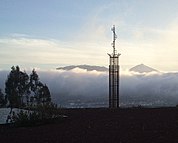
Memorial on Tenerife

Westgaarde Cemetery

Westminster Memorial Park
A Dutch national memorial and last resting identify for the victims of the KLM plane is located in Amsterdam, at Westgaarde cemetery. There is also a memorial at the Westminster Memorial Park and Mortuary in Westminster, California.
In 1977, a cross in Rancho Bernardo was dedicated to xix area residents who died in the disaster.[71] [72]
In 2007, the 30th anniversary marked the first time that Dutch and American adjacent-of-kin and assist helpers from Tenerife joined an international commemoration service, held at the Auditorio de Tenerife in Santa Cruz. The International Tenerife Memorial March 27, 1977, was inaugurated at the Mesa Mota on March 27, 2007. The monument was designed past Dutch sculptor Rudi van de Wint.[73]
Documentaries [edit]
The disaster has been featured in many TV shows and documentaries. These include the Survival in the Heaven episode "Blaming the Pilot", the Seconds From Disaster episode "Standoff on the Runway", PBS'south NOVA episode "The Deadliest Airplane Crash" in 2006, the PBS special Surviving Disaster: How the Brain Works Under Extreme Duress (based on Amanda Ripley's book The Unthinkable: Who Survives When Disaster Strikes - and Why) in 2011, Destroyed in Seconds and an episode of the Canadian TV series Mayday (known by different names in unlike countries), namely the flavor sixteen standard length episode "Disaster at Tenerife" with the earlier more in-depth ninety-minute "Crash of the Century" being a spin-off. Footage was included in the 1979 moving-picture show Days of Fury, narrated by Vincent Cost.
Encounter also [edit]
- Listing of accidents and incidents involving commercial aircraft
References [edit]
- ^ Tedeschi, Diane (June 2019). "Crash in the Canary Islands". Air & Space Magazine . Retrieved October 17, 2019.
- ^ a b c "580 killed in history'due south worst air disaster". Eugene Register-Baby-sit. (Oregon). Associated Press. March 28, 1977. p. 1A.
- ^ a b c "Dutch pilot blamed for air disaster". Eugene Annals-Guard. (Oregon). Associated Press. March 29, 1977. p. 1A.
- ^ a b c d e f one thousand h i j "ASN Blow Description". Aviation Safety Network. Retrieved May 11, 2011.
- ^ a b c "Dutch comments on the Spanish report" (PDF). Projection-Tenerife.com. Archived (PDF) from the original on September 21, 2006.
- ^ a b "How KLM accepted their responsibility for the blow". Project-Tenerife.com. Archived from the original on August 22, 2007.
- ^ Baron, Robert. "The Cockpit, the Cabin, and Social Psychology". Global Operators Flight Data Resources. Retrieved May 11, 2011.
- ^ a b Kilroy, Chris. "Special Report: Tenerife". AirDisaster.com. Archived from the original on October 18, 2007.
{{cite spider web}}: CS1 maint: unfit URL (link) - ^ "Official written report" (PDF). (v.98 MB), section five.2, p. 38 (PDF p. 41 of 63)"
- ^ a b c d e f Job, Macarthur (January 1995). Air Disaster, Volume 1. Motorbooks International. pp. 164–180. ISBN978-1875671113.
- ^ a b "The Deadliest Plane Crash". PBS. Oct 17, 2006. Retrieved September 23, 2014.
- ^ "A 24-hour interval of "Firsts"". Pan Am Historical Foundation.
- ^ Markham, James M. (Apr 2, 1977). "Wreck of 747's Sets Back Cause Of Insurgents on Canary Islands" (from NYT athenaeum). The New York Times.
- ^ a b c "The Tenerife Airport Disaster – the worst in aviation history". tenerife information centre. March 27, 1977. Retrieved Apr eleven, 2017.
- ^ Ebert, John David (2012). The Historic period of Catastrophe: Disaster and Humanity in Modern Times. McFarland. p. 41. ISBN978-0-7864-7142-3.
V large planes had been diverted to Las Rodeos, ...
- ^ ten Voorde, Gerard (March 21, 2017). "Enige overlevende KLM-toestel vliegramp Tenerife blikt na veertig jaar terug" [Only surviving KLM aeroplane Tenerife plane crash looks back after forty years]. Reformatorisch Dagblad (in Dutch). Retrieved July 24, 2021.
- ^ "Official report" (PDF). (5.98 MB), p. 2 (PDF p. 5 of 63)
- ^ "Official written report" (PDF). (5.98 MB), pp. three–4 (PDF pp. 6–7 of 63)
- ^ "Official report" (PDF). (5.98 MB), p. 3 (PDF p. 6 of 63)
- ^ "Official study" (PDF). (v.98 MB), pp. 56–57 (PDF pp. 59–60 of 63)
- ^ "Official report, addendum 6" (PDF).
- ^ "ALPA report on the crash" (PDF). Archived from the original (PDF) on July 15, 2011. (two.70 MB), p. xix (PDF p. 23 of 97)
- ^ "Official written report" (PDF). (five.98 MB), p. 46 (PDF p. 49 of 63)
- ^ "ALPA report on the crash" (PDF). Archived from the original (PDF) on July fifteen, 2011. (2.lxx MB), p. 8 (PDF p. 12 of 97)
- ^ "ALPA report on the crash" (PDF). Archived from the original (PDF) on July 15, 2011. (2.70 MB), p. 11 (PDF p. 15 of 97)
- ^ "ALPA report on the crash" (PDF). Archived from the original (PDF) on July 15, 2011. (ii.70 MB), p. 12 (PDF p. xvi of 97)
- ^ "The Tenerife crash – March 27th, 1977". 1001crash.com . Retrieved June 28, 2016.
- ^ "Copy of the Spanish Report" (PDF). Projection-Tenerife.com. November 16, 1978. Retrieved May 5, 2012.
- ^ "Cockpit Voice Recorders: Transcripts: KLM 4805". AirDisaster.com. Archived from the original on Apr xx, 2012. Retrieved May 5, 2012.
{{cite web}}: CS1 maint: unfit URL (link) - ^ Krause, Shari S. (2003). Shipping Safety: Accident Investigations, Analyses, & Applications (2d ed.). McGraw-Loma. p. 205. doi:x.1036/0071433937 (inactive February 28, 2022). ISBN978-0-07-140974-ii.
{{cite volume}}: CS1 maint: DOI inactive equally of February 2022 (link) - ^ Krock, Lexi (October 17, 2006). "NOVA: The Final Viii Minutes". PBS Online . Retrieved May 5, 2012.
- ^ Croucher, Phil (2005). JAR Professional person Pilot Studies. Electrocution Technical Publishers. p. 67. ISBN978-0-9681928-ii-5.
- ^ "Official CVR transcript" (PDF). project-tenerife.com . Retrieved June 4, 2021.
- ^ a b "Concluding Report" (PDF). Netherlands Aviation Prophylactic Board. p. 46. Retrieved July 12, 2021.
- ^ Official report, p.48
- ^ Bruggink, Gerard M. "Remembering Tenerife". Air Line Airplane pilot (August 2000, Page 18). Archived from the original on May 13, 2006. Retrieved February 24, 2014.
- ^ "Air travel's communications killer". Salon.com. March 28, 2002. Archived from the original on February one, 2013.
- ^ "1977 Yr in Review: Terrorism". UPI.com. 1977. Archived from the original on Jan 4, 2012. Retrieved July 19, 2021.
- ^ "Advertizement: KLM. From the people who made punctuality possible". Projection-Tenerife.com. Archived from the original on Jan 21, 2012. Retrieved December 21, 2012.
- ^ Reijnoudt, Jan; Sterk, Niek (2002). Tragedie op Tenerife: de grootste luchtramp, optelsom van kleine missers [Tenerife tragedy: biggest air disaster, sum of small mistakes]. Kok. ISBN978-9043504522.
- ^ "KLM aeroplane crashes". AirSafe.com . Retrieved October 12, 2007.
- ^ "Passenger listing of the PanAm". ProjectTenerife.com. Retrieved Feb x, 2016.
- ^ "San Jose Within – Dutch Hamann – Part 2". Sanjoseinside.com. January 23, 2006. Retrieved May 5, 2012.
- ^ "Canary Island Separatist Says Group Planted Bomb But Did Non Crusade Crash". The New York Times. Agence France-Presse. March 28, 1977. Retrieved December 20, 2018.
- ^ "Experts converge on Canaries to probe plane crash". Chicago Tribune. March 29, 1977. p. ane. Retrieved June 29, 2020.
- ^ "Air crash victims flown home". Eugene Annals-Baby-sit. (Oregon). UPI. March 30, 1977. p. 1A.
- ^ "Desert Sun 29 March 1977 — California Digital Newspaper Collection". cdnc.ucr.edu . Retrieved June 28, 2016.
- ^ a b "thirty Mar 1977, Page iv - The Naples Daily News". Newspapers.com . Retrieved June xix, 2016.
- ^ "Crash drome open again". New Nation (Singapore). NLB. Apr 4, 1977. p. five. Retrieved June 28, 2016.
- ^ "The Deadliest Airplane Crash - The Concluding Viii Minutes". Nova . Retrieved Oct 17, 2019.
- ^ "B742 / B741, Tenerife Canary Islands Spain, 1977 - SKYbrary Aviation Condom". world wide web.skybrary.aero. Apr 5, 2021. Retrieved June iii, 2021.
- ^ "Official report" (PDF). (5.98 MB), pp. 61–62
- ^ Curran, William J. (November 3, 1977). "The Medicolegal Lessons of the Tenerife Disaster". The New England Periodical of Medicine. 297 (eighteen): 986–987. doi:10.1056/NEJM197711032971806. ISSN 0028-4793. PMID 909545.
- ^ "Final written report and comments of kingdom of the netherlands Aviation Prophylactic Board" (PDF). Project-Tenerife.com. pp. lx–61 (PDF pp. xl–41). Archived (PDF) from the original on September 27, 2007.
- ^ a b Religion, Nicholas (August 2012) [1996]. Black Box: Inside the World'southward Worst Air Crashes. Monday Books. pp. 176–178. ISBN978-1906308469.
- ^ The Washington Mail, March 25, 1980
- ^ "ALPA report on the crash" (PDF). Archived from the original (PDF) on July 15, 2011. (2.70a MB), p. ii (PDF p. vi of 97). "The written report grouping notes with approval that the official report of the spanish government has, itself, included a department on human factors involved in this accident. Nosotros experience that this is an excellent commencement toward a better understanding of the causal factors of aviation accidents, an thought whose fourth dimension has finally come."
- ^ Weick, Karl E. (September 1, 1990). "The Vulnerable System: An Analysis of the Tenerife Air Disaster" (PDF). Periodical of Management. 16 (3): 571–593. doi:10.1177/014920639001600304. hdl:2027.42/68716. S2CID 145765387.
- ^ "Official report" (PDF). (v.98 MB), section 5.two, p. 38 (PDF p. 41 of 63): "... these circumstances could have induced the co-pilot not to ask any questions, bold that his captain was always right"
- ^ Bartelski, Jan (2001). Disasters in the air: mysterious air disasters explained . Airlife. ISBN978-1-84037-204-5.
- ^ "ALPA report on the crash" (PDF). Archived from the original (PDF) on July 15, 2011. (ii.70 MB), p. 22 (PDF p. 26 of 97). "Both pilots were contending with heavy demands on their attending as the visibility rapidly worsened. The flight engineer, to the reverse, had completed the heaviest part of his workload and was now reverting to an instrument monitoring manner."
- ^ "ALPA report on the crash" (PDF). Project-Tenerife.com. Archived from the original (PDF) on July xv, 2011. (2.lxx MB), p. 22 (PDF p. 26 of 97). "It is our opinion that the flight engineer, similar the pilots, did not perceive the bulletin from the controller to the Pan Am asking them to study when runway clear. (Because of the apply of the address "Papa Alpha)."
- ^ "CIAIAC | Publications | Relevant reports | A-102/1977 and A-103/1977 ii.one Analysis". fomento.es (in Spanish). Government of Espana. Archived from the original on Apr 12, 2009. This Castilian report states 55,500 liters of jet fuel; based on a density of 0.8705 kg/l, that would weigh 45 metric tons or 49 Us tons.
- ^ The Deadliest Plane Crash - transcript, NOVA,
The 55 tons of fuel the Dutch plane had taken on creates a massive fireball that seals the fate of everyone onboard
- ^ "World's deadliest airline disaster occurred 36 years ago today". Crossroads Today. Saga Dissemination, LLC. March 27, 2013. Archived from the original on July 31, 2013.
The full load of new fuel ignited immediately.
- ^ CAP 413 Radio Telephony Manual (Edition xv), chapter 2 page half dozen
- ^ CAP 413 Radio Telephony Manual (Edition 15), affiliate 4, page 6, paragraph 1.seven.10
- ^ Alexander, David (2015). Never Expect for the Fire Truck: How the Worlds Deadliest Plane Crash Changed My Life and Yours. New York: Createspace Independent. ISBN978-0692471876. "Tenerife Disaster – 27 March 1977: The Utility of the Swiss Cheese Model & other Accident Causation Frameworks". Go Flying Medicine. Retrieved Oct 13, 2014.
- ^ Helmreich, R. 50.; Merritt, A. C.; Wilhelm, J. A. (1999). "The Evolution of Crew Resource Direction Preparation in Commercial Aviation" (PDF). Int. J. Aviat. Psychol. 9 (1): xix–32. CiteSeerXten.1.1.526.8574. doi:10.1207/s15327108ijap0901_2. PMID 11541445. Archived from the original (PDF) on March half dozen, 2013.
- ^ "Tenerife North airport will get a new command belfry, more than than 30 years afterwards globe's biggest air disaster". www.tenerife-training.internet . Retrieved March 4, 2017.
- ^ kacejataste (January 29, 2009). "Around the Ranch: All nigh Battle Mount". The San Diego Union-Tribune. Pomerado News. Retrieved May 5, 2018.
- ^ Himchak, Elizabeth Marie (June 9, 2016). "Rancho Bernardo cross undergoes repairs". The San Diego Matrimony-Tribune . Retrieved May five, 2018.
- ^ "COMUNICADO: Monumento International Tenerife Memorial donado al Cabildo; avanzan los trabajos de cimentación en la Mesa Mota". El Economista (in Spanish). February 19, 2007. Retrieved March 21, 2012.
- Collision on Tenerife: The How and Why of the World's Worst Aviation Disaster past Jon Ziomek (Post Hill Printing, 2018).
External links [edit]
| External media | |
|---|---|
| Images | |
 PH-BUF (KLM 4805) - Airliners.cyberspace PH-BUF (KLM 4805) - Airliners.cyberspace | |
| N736PA (Pan Am 1736) - Airliners.net | |
| Video | |
 Survivor remembers deadliest aviation disaster in Tenerife - CBS This Morning time - March 27, 2017 Survivor remembers deadliest aviation disaster in Tenerife - CBS This Morning time - March 27, 2017 |
- Official Spanish and Dutch accident reports
- English translation of Spanish report and Dutch response
- "A-102/1977 y A-103/1977 Accidente Ocurrido el 27 de Marzo de 1977 a las Aeronaves Boeing 747, Matrícula PH-BUF de Thou.L.One thousand. y Aeronave Boeing 747, matrícula N736PA de PANAM en el Aeropuerto de los Rodeos, Tenerife (Islas Canarias)." - Hosted by the Ceremonious Aviation Accident and Incident Investigation Commission (in Castilian)
- Human being Factors Study on the Tenerife Accident - Air Line Pilots Clan of the United states (Archive)
- Project Tenerife — website well-nigh the Tenerife disaster
- Watch Days of Fury at the Internet Archive
Source: https://en.wikipedia.org/wiki/Tenerife_airport_disaster

Enregistrer un commentaire for "Airline Disaster Crash of the Century Movie Review"