Ancient Chinese Mechanical Clock Ancient Chinese Mechanical Clock Clip Art
Papermaking, gunpowder, printing and the compass are four nifty inventions past ancient Chinese people that have had a huge impact on the unabridged world.
Paper Making
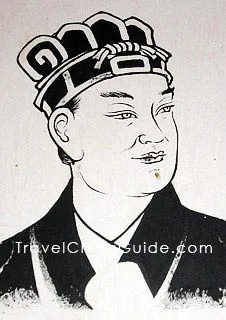 |
| Cai Lun, inventor of papermaking |
The invention of paper greatly contributed to the spread and evolution of culture. Before its invention, basic, tortoise shells, and bamboo slips were all used as writing surfaces, simply equally Chinese civilization developed they proved themselves unsuitable because of their bulk and weight. Hemp fiber and silk were used to make paper only the quality was far from satisfactory. Besides, these two materials could be better used for other purposes then information technology was not applied to make paper from them.
Xue fu wu che is a Chinese idiom describing a learned man. The story behind information technology concerns a scholar named Hui Shi who lived during the Warring States Period. He needed five carts to carry his books when he traveled around teaching. Books at that time were made of wood or bamboo slips so they were heavy and occupied a lot of space. Reading at the time needed not only brainwork but also concrete force.
In 105 A.D. Cai Lun, a eunuch during the Eastern Han Dynasty, invented paper from worn fishnet, bark and textile. These raw materials could exist easily plant at a much lower cost so big quantities of paper could exist produced.
The making technique was exported to Korea in 384 A.D. A Korean Monk then took this skill with him to Japan in 610 A.D.
During a state of war between the Tang Dynasty and the Arab Empire, the Arabs captured some Tang soldiers and paper making workers. Thus, a paper factory was gear up up by the Arabs.
In the 11th Century the skill was carried to India when Chinese monks journeyed there in search of Buddhist sutras.
Through the Arabs, Africans and Europeans so mastered the skill. The first paper manufacturing plant in Europe was prepare in Spain. In the latter half of the 16th century, this skill was brought to America. By the 19th century, when paper factories were set up in Australia, paper making had spread to the whole world.
Cai Lun, likewise known as Tsai Lun, was listed in the book The 100: A Ranking of the Most Influential Persons in History by Michael H. Hart.
Gunpowder
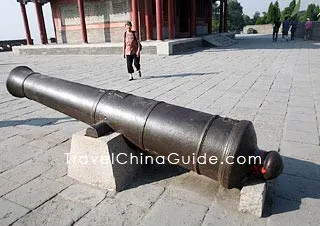 |
| Cannon |
In Chinese, gunpowder is chosen huo yao, meaning flaming medicine. Unlike paper and printing, the birth of gunpowder was quite accidental. It was offset invented inadvertently by alchemists while attempting to make an elixir of immortality. It was a mixture of sulphur, saltpeter, and charcoal. At the end of the Tang Dynasty, gunpowder was being used in armed forces affairs. During the Song and Yuan Dynasties, frequent wars spurred the development of cannons, and fire-arrows shot from bamboo tubes.
In the 12th and 13th centuries, gunpowder spread to the Arab countries, then Hellenic republic, other European countries, and finally all over the earth.
Printing Technique
Inspired by engraved proper noun seals, Chinese people invented fixed-type engraved printing effectually 600 A.D. The skill played an of import role in the Song Dynasty but its shortcomings were credible. Information technology was time-consuming to engrave a model, not easy to store, and non easy to revise errors.
During the reign of Emperor Ren Zong of the Northern Song Dynasty, Bi Sheng invented moveable, reusable clay type afterward numerous tests. Single types were made and picked out for printing sure books. These types could exist used again and again for dissimilar books. Because of the large number of different characters in the Chinese written language, this technique did not have a dramatic impact at the time. However, today, this typesetting technique is regarded every bit a revolution in the industry. Nigh 200 years afterward, this moveable-blazon technique spread to other countries and advanced the development of world civilisation.
Compass
During the Warring States period, a device called a Si Nan became the forerunner of the compass. A Si Nan was a ladle-like magnet on a plate with the handle of the ladle pointing to the due south. In the 11th century, tiny needles made of magnetized steel were invented. Ane end of the needle points n while the other points southward. The compass was thus created. The compass greatly improved a ship'due south ability to navigate over long distances. It was not until the commencement of the 14th century that compass was introduced to Europe from China.
- Last modified on May. 14, 2021 -
Source: https://www.travelchinaguide.com/intro/focus/inventions.htm

Enregistrer un commentaire for "Ancient Chinese Mechanical Clock Ancient Chinese Mechanical Clock Clip Art"