What Type of Unemployment Was That Again
Unemployment: Its Measurement and Types
Download the complete Explainer 278KBThe unemployment rate is the virtually unremarkably used indicator for understanding conditions in the labour market. The labour market is the term used past economists when talking nearly the supply of labour (from households) and demand for labour (past businesses and other organisations). The unemployment rate can also provide insights into how the economic system is performing more generally, making it an of import factor in thinking about monetary policy.
This explainer outlines 2 key topics related to unemployment.
- How is the unemployment rate measured?
- What are the main types of unemployment?
How is the unemployment charge per unit measured?
Unemployment occurs when someone is willing and able to work but does not have a paid task. The unemployment rate is the percentage of people in the labour force who are unemployed. Consequently, measuring the unemployment rate requires identifying who is in the labour force. The labour force includes people who are either employed or unemployed. Figuring out who is employed or unemployed involves making practical judgements, such equally how much paid work someone needs to undertake for them to exist considered every bit having a job, too every bit actually counting how many people have jobs or not.
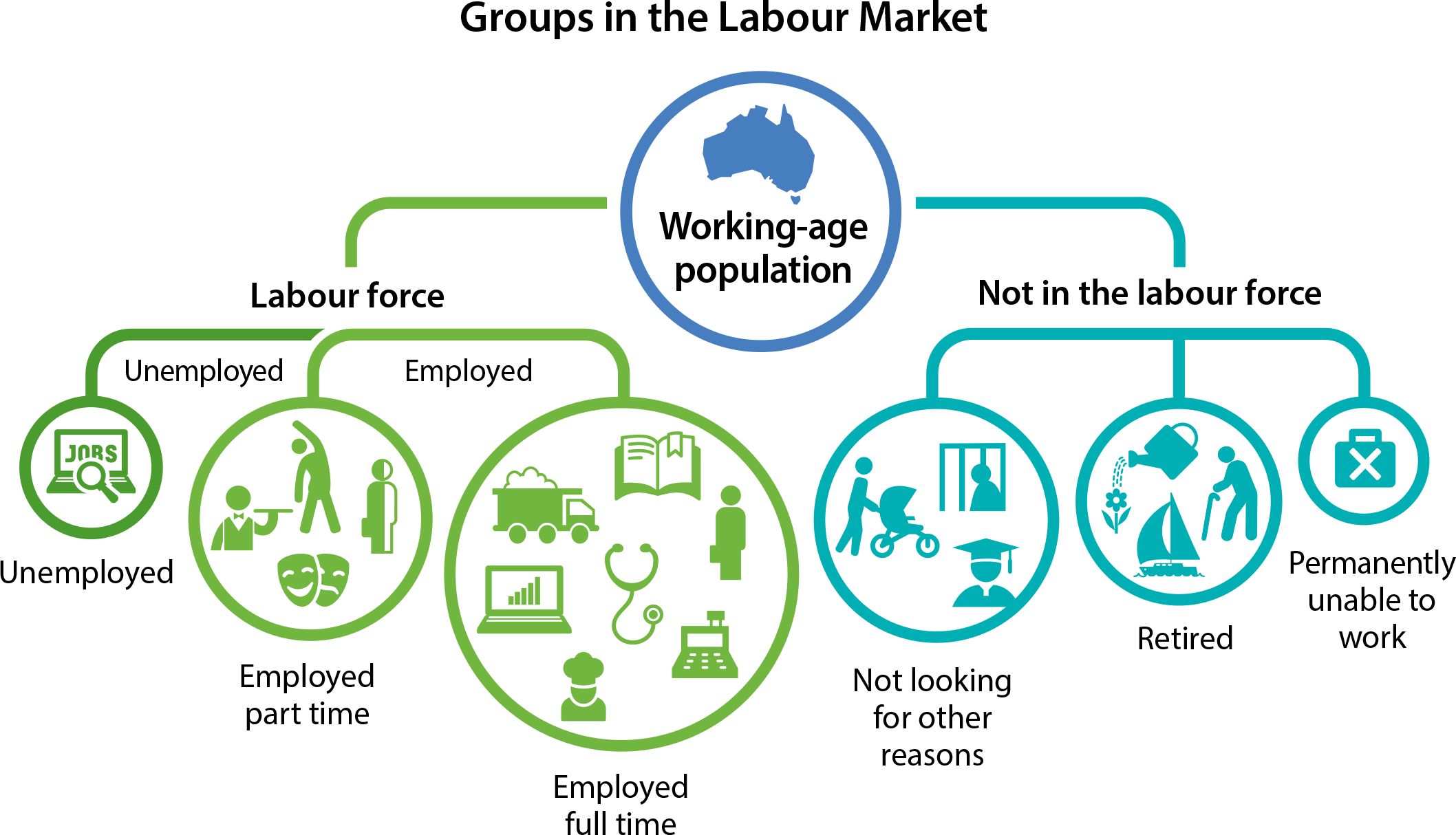
In Commonwealth of australia, the Australian Bureau of Statistics (ABS) is responsible for collecting labour marketplace data. The ABS conducts a survey each month – chosen the Labour Force Survey – in which it asks effectually l,000 people near their participation in the labour market. As part of this survey, the ABS groups people anile 15 years and over (the working-age population) into three broad categories:
- Employed – includes people who are in a paid job for ane hour or more in a calendar week.
- Unemployed – includes people who are not in a paid job, merely who are actively looking for work.
- Non in the labour force – includes people non in a paid chore, and who are not looking for work.
This can include people who are studying, caring for children or family unit members on a voluntary basis, retired, or who are permanently unable to work.
Once the number of people in each of these categories has been estimated, the post-obit labour marketplace indicators can be calculated:
- Labour force – the sum of employed and unemployed people.
- Unemployment rate – the percent of people in the labour forcefulness that are unemployed.
- Participation rate – the percentage of people in the working-age population that are in the labour force.
Box: Calculating the Unemployment Rate – An Example
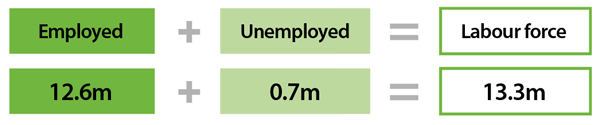
To sympathize how the unemployment rate is calculated nosotros can employ an example. In this example 12.vi million people are employed and 0.7 million people are unemployed. The size of the labour force is calculated equally the sum of these groups.
With the unemployment charge per unit being the percentage of people in the labour strength who are unemployed, using the numbers in our example and the equation below, the unemployment rate is calculated as 5.3 per cent.
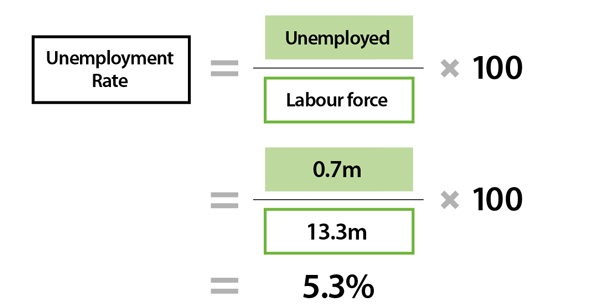
The unemployment charge per unit is affected by changes in the number of unemployed people (the numerator), which can outcome from cyclical factors, such every bit the number of people who become unemployed because of an economic downturn, or more structural factors in the economic system (see 'What are the principal types of unemployment?' below). The unemployment rate is besides afflicted by changes in the size of the labour forcefulness (the denominator).
Box: Calculating the Participation Charge per unit – An Example
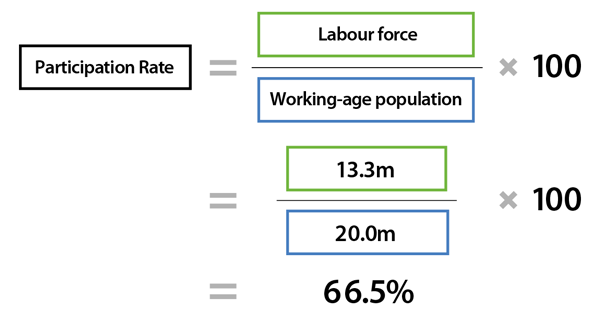
The participation charge per unit expresses the labour force as a percentage of the working-age population. The working-age population includes Australian residents aged fifteen years and over (with some exceptions, such as permanent defense members).
Using the numbers in the instance higher up there are thirteen.3 million people in the labour strength and, if the working-age population is 20.0 million people, the participation rate is 66.5 per cent.
Labour force participation typically moves with the business cycle. When businesses are hiring more workers and offering college wages, the incentives are greater to actively await for piece of work. In dissimilarity, when businesses are not hiring and offering smaller wage increases, there is less of an incentive for people to look for work.
At that place are as well structural influences affecting labour force participation that are contained of the business concern cycle. Some examples of trends that have affected the participation rate in the past include: more opportunities to piece of work office fourth dimension; an increase in the number of females looking for work (increased female participation); and people working for longer as they delay their retirement.
What are the principal types of unemployment?
There are three main types of unemployment – cyclical, structural and frictional unemployment. In practice, these cannot be measured directly, and they tin ofttimes overlap, but they provide a useful way of thinking most unemployment.
Cyclical Unemployment
Cyclical unemployment occurs with changes in economic action over the concern cycle.
During an economic downturn, a shortfall of need for goods and services results in a lack of jobs being available for those who desire to work. Businesses experiencing weaker demand might reduce the corporeality of people they utilise by laying off existing workers, or hiring fewer new workers. Every bit a result, people looking for work will likewise discover it harder to get employed. The opposite state of affairs occurs when demand strengthens.
Cyclical unemployment is often described as beingness medium term in nature (one to 12 months). Examples can be seen in the unemployment rate ascent sharply with the early 1990s recession, declining to depression levels by the mid 2000s before rising once more around the time of the global financial crisis.
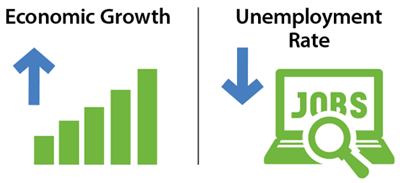
An increment in cyclical unemployment might propose the economy is operating beneath its potential. With more than people competing for jobs, businesses might offer lower wage increases, which would contribute to lower inflation. Policies that stimulate amass demand, such as expansionary budgetary policy, can assist reduce this type of unemployment (because businesses experiencing stronger need are likely to employ more than people).
Structural Unemployment
Structural unemployment occurs when at that place is a mismatch between the jobs that are available and the people looking for work. This mismatch could exist because jobseekers don't have the skills required to do the bachelor jobs, or because the available jobs are a long way from the jobseekers.
Workers may get unemployed if they work in industries that are declining in size or have skills that could exist automatic equally a upshot of large-scale technological advances. It may be hard for them to find work in another industry and they may need to develop new skills or motion to a region that has more than opportunities.
For example, there has been a noticeable decline in the share of people employed in routine manual jobs over recent decades with some of these jobs being automatic considering of advances in engineering science. The manufacturing industry is an example of an industry that has a high share of routine transmission jobs and its size in the economic system has declined (both in terms of product and employment).
Structural unemployment tends to be longer lasting than other types of unemployment. This is because information technology can take a number of years for workers to develop new skills or motion to a unlike region to find a job that matches their skills. As a result, workers who are unemployed because of structural factors are more than probable to face up long-term unemployment (for more 12 months).
In contrast to cyclical unemployment, structural unemployment exists even when economic weather are skillful. In theory, this type of unemployment should not directly influence wages or inflation and is best addressed through policies that focus on skills and the supply of labour.
Frictional Unemployment
Frictional unemployment occurs when people move between jobs in the labour marketplace, too every bit when people transition into and out of the labour forcefulness.
Movement of workers is neccessary for a flexible labour market and helps attain an efficient allocation of labour across the economy. Notwithstanding, people may non notice jobs immediately and need to invest time and effort in searching for the right task. Businesses also spend fourth dimension searching for suitable candidates to fill job vacancies. As a result, people looking for jobs are not matched immediately with vacancies and may experience a period of temporary unemployment.
This blazon of unemployment is by and large shorter term (less than one month). Frictional unemployment is likely to occur at all points of the business concern cycle and, like structural unemployment, may non influence wages or inflation.
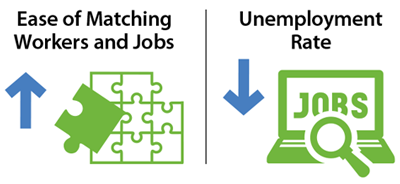
These three types of unemployment are not independent of each other. For example, a period of high cyclical unemployment might lift structural unemployment. This could occur when people are unemployed for such a long period that their skills and productivity deteriorate, and they become seen equally beingness less employable, reducing the probability that they will exist hired in the hereafter.
Other Types of Unemployment
There are another types of unemployment that are also important to consider. In item, the underemployment rate tin exist idea of as a complementary indicator to the unemployment rate when thinking about weather in the labour market.
- Underemployment occurs when people are employed, merely would like and are available to work more hours. There are ii categories of underemployed people defined by the ABS. Commencement, part-time workers who would adopt to work additional hours. Second, people who usually work full fourth dimension, but are currently working part-fourth dimension hours. Underemployment rates are generally higher amid groups that accept a larger proportion of people working part fourth dimension, such as females, younger workers and older workers.
- Hidden unemployment occurs when people are not counted every bit unemployed in the formal ABS labour market statistics, but would probably work if they had the chance. For example, someone might accept looked for work for a long time, given up hope and stopped looking, but still wish to work. (These people are sometimes referred to every bit 'discouraged workers'.)
- Seasonal unemployment occurs at different points over the year because of seasonal patterns that affect jobs. Some examples include ski instructors, fruit pickers and holiday-related jobs. The ABS publishes seasonally adjusted labour market statistics, which remove seasonal patterns in the data.
Source: https://www.rba.gov.au/education/resources/explainers/unemployment-its-measurement-and-types.html

Enregistrer un commentaire for "What Type of Unemployment Was That Again"