Micro Bubble Air Separator for Steam Boiler Water Feed
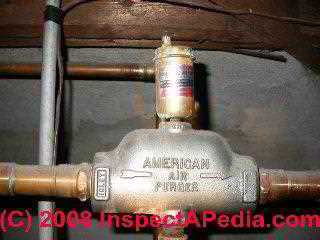 Heating Boiler Air Scoops
Bulk Air Separators & Air Purgers
- POST a QUESTION or COMMENT about air scoops or air separators on hot water heating systems: installation, troubleshooting, repair
InspectAPedia tolerates no conflicts of interest. We have no relationship with advertisers, products, or services discussed at this website.
Hot water heating system air scoops, air separators & air scoops:
What a bulk air eliminator or "air scoop"does, where they belong, how they work to prevent noise and loss of heat in hydronic heating systems.
Automatic air removal from hot water heating systems avoids air-bound boilers, baseboards, radiators, radiant heat loops. What is the function of the air scoop automatic air purger on heating systems? Common manufacturers of bulk air eliminators include American air purgers, Taco air scoops, Sparco air purgers, Bell & Gossett inline air separators
This article series answers most questions about central hot water heating system troubleshooting, inspection, diagnosis, and repairs. We describe how to inspect, troubleshoot and repair heating and air conditioning systems to inform home owners, buyers, and home inspectors of common heating system defects.
We also provide an ARTICLE INDEX for this topic, or you can try the page top or bottom SEARCH BOX as a quick way to find information you need.
Air Scoops, Air Separators, Air Purgers on Hot Water Heating Systems Eliminate Air and Noise & Prevent Air Bound Loss of Heat
 Hot water heating systems, whether using baseboards, convectors, radiators, or even radiant tubing, can be noisy if there is air circulating in the system.
Worse, as we discuss at AIRBOUND HEAT SYSTEM REPAIR by WATER FEED VALVE, if the amount of air is excessive, the circulator pump(s) may not be able to circulate hot water at all and portions of the heating system (radiators, baseboards etc) may just stay cold.
Air is dissolved in cold water in any hydronic heating system. When we heat the water, some of that air returns to a gas form as air bubbles that cause noise heard at circulator pumps, in the hot water piping, or in radiators or baseboards.
Air might also enter a hot water heating system due to a leak in piping that lets water out when the system is hot and lets air in when the heating system is cold. Of course there are other causes of noise in heating systems, but air in the piping is perhaps the most common noise complaint.
Taco™, a manufacturer of heating system components and controls, provides this clear explanation of the function of the air scoop or air separator on a hot water heating system:
The Taco Air scoop is specifically designed to provide a noiseless, air-free hydronic heating, cooling or combination system, by efficiently separating out the air from the water in any of these systems.
Air being lighter than water, it travels along the upper portion of a horizontal pipe in low velocity hydronic systems. As the air and water enter the Air Scoop their velocity decreases, permitting the air bubbles to be scooped up by the baffle and directed to the top of the chamber.
The air reaching the top of the air scoop is either immediately vented through a Hy-Vent or it moves into a conventional plain steel expansion tank, if used.
Should the air completely fill the plain steel tank and back down into the Air Scoop, the excess will be removed by the Hy-Vent without disturbing the operation of the system.
Also see AIR BLEEDER VALVES that work with air scoops to remove un-wanted air from hydronic (hot water) heating systems. Air in heating distribution piping, boilers, radiators, can prevent hot water circulation and thus stop heat from being delivered to the occupied space.
For a complete list of diagnostic articles for radiators or baseboards that do not get hot when they should includes
see AIR-BOUND HEATING SYSTEMS.
Air Troubles on Hot Water Heating Systems& the Air Scoop
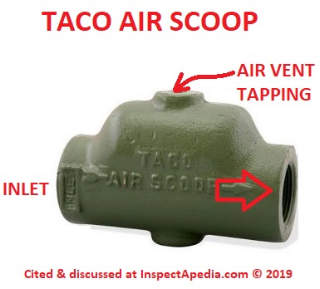
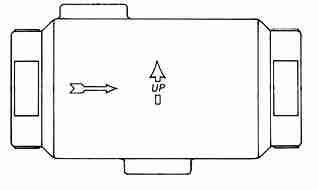
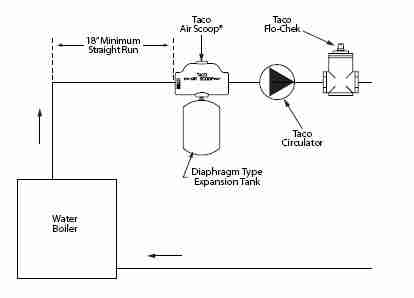 Install the air scoop in the right direction: Notice the arrow cast into the body of the Taco™ air scoop (photo above, sketch at left) and on the sketch of the Sparco™ air purger below?
[Click to enlarge any image]
Make sure that your air scoop is installed in the right direction, consistent with the intended flow of hot water in the heat distribution piping. Installing the device backwards, a common error on both air scoops and flow-check valves, is likely to prevent it from working.
If a check valve is installed, make sure it too is installed in the right direction. Your system may not use a check valve if its circulator pump incorporates an internal flow check valve (IFC).
If your hot water heating system is noisy, is not automatically purging air, or is air bound, in addition to purging un-wanted air manually and finding and fixing any leaks that are letting air into the heating distribution piping or boiler, be sure that your air scoop is properly installed.
Make sure the air vent is working: Even if the air scoop is properly installed and located (see Taco's sketch, above), if the "Hy Vent" or "Float Vent" or automatic air purge valve (these are all synonyms from different manufacturers) is not working the system may not successfully purge air.
See AIR BLEEDER VALVES, and
see AIRBOUND HEAT SYSTEM REPAIR by WATER FEED VALVE.
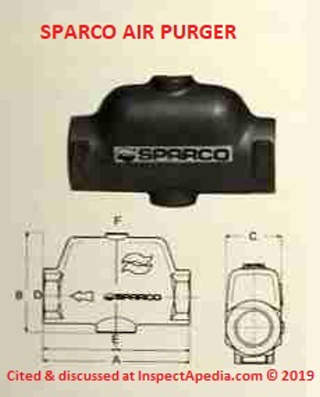
Above we illustrate another air purger manufactured by Sparco [now Honeywell Sparco - Ed.]
Below we include a sketch of Bell & Gosset's inline air separator (IAS). The B&G inline air separator has the same function as the air scoops discussed above, but its internal workings are a bit different. Here is B&G's explanation of how their IAS works:
"IAS stands for Inline Air Separator. It has two chambers, and it's a bit wider than the pipe it serves. We separated the two chambers with an orifice, and therein lies the secret to the IAS's great performance.
"An orifice is a hole that's a bit smaller than the chamber itself. Air-laden water flows down the pipe and enters the "wide space in the road" - the IAS. Naturally, as the water widens out in the IAS, it also slows down. That slowing motion releases the air bubbles in the same way a slowing river current releases floating debris.
"The air bubbles quickly float to the top of the first chamber and get trapped by the wall of iron that makes up the orifice and flows to the radiators. Since the IAS snatches the air out of the flow just as it leaves the boiler; the air doesn't get a chance to create problems out in the system.
"Once captured, the IAS vents the air out of the system through an automatic air vent, which you'll install in the IAS's top tapping. If you're using a plain steel compression tank, the IAS will pass the air up into the tank. " - Bell & Gossett
Installation Guides for Air Eliminators Air Scoops Air separators on Hydronic Heating Systems
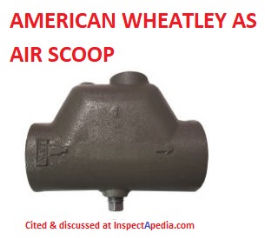
Alphabetical list of air scoops and air eliminators.
- American Wheatley Air Purgers & Air Scoops, [shown above] Global Flow Products 2701 W Concord St. Broken Arrow, Oklahoma 74012 USA Tel: 866-204-5229 Email: sales@globalflowproducts.com Website: https://www.wheatleyhvac.com/air-scoops
Website excerpt:The American Wheatley AS Series air scoop operates on the premise that air will rise in the piping and then into air scoop, being directed to the top opening and out of the system through an air vent or to an expansion tank.
Since proper operation of this type of air separator is also dependant on velocity, sizing this type of air separator is a function of proper flow rate. This type of air separation is best suited for residential and light commercial applications.
- Bell & Gossett Air Separators and other heating system components, 8200 N. Austin Ave., Morton Grove IL 60053, USA - Tel 847 966-3700 Fax 847 965-8379 . Air separators are discussed by B&G at http://www.bellgossett.com/homeowners/BG-airseparator.asp
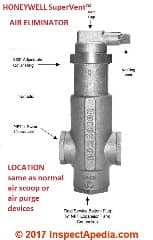
- Honeywell Sparco air purgers, air scoops, and other heating system components & controls
- HONEYWELL PV-Series Residential SuperVent™ Air Eliminator [PDF] (2005) Honeywell International Inc., 1985 Douglas Drive North 35 Dynamic Drive, Golden Valley, MN 55422
Honeywell Limited-Honeywell Limited, Toronto, Ontario M1V 4Z9 Email: customer.honeywell.comretrieved 2018/01/27, original source https://forwardthinking.honeywell.com/related_links/water/supervent/install/62-3069.pdf
Excerpt:The Honeywell SuperVent automatically eliminates air and micro-bubbles from hydronic heating and cooling systems without bleeding. The SuperVent guarantees fast start-up with automatic venting, helps prevent corrosion of system components, and improves system efficiency.
Additionally, the Honeywell SuperVent micro-bubble concentrator has three times the impact area of other products.
- SPIROVENT®JUNIOR microbubble separators, air, dirt separators, Catalog & specifications [PDF] Spirovent Model VJP100 selected based on a 1" pipe diameter adn 5 gpm water flow - other models are available. Retrieved 2018/01/27, original source: http://www.spirotherm.com/sites/default/files/JR-3.pdf
Excerpt:Unlike conventional air eliminators or air scoops, the Spirovent completely eliminates 100% of the free air, 100% of the entrained air, and up to 99.6% of the dissolved air in the system. Consisting of woven copper wire soldered to a copper tube, the patented Spirotube creates a low velocity area in the Spirovent that scrubs the bubbles from the water.
The air bubbles rise and collect in the air chamber before they are vented from the system via an integral automatic valve. Air problems become a thing of the past.
Spirotherm, SpiroVent® Air Eliminators, Air Separators, Dirt Separators, Spirotherm, Inc., 25 N. Brandon Drive, Glendale Heights, IL 60139 USA, Tel.: 630-307-2662 E-mail: info@spirotherm.com Website: http://www.spirotherm.com/
- Taco AIR ELIMINATION & CONTROL MANUAL [PDF] describes models of Taco in-line air separators and gives schematics and details for installation.
Taco Inc., 1160 Cranston Street. Cranston, RI 02920 / (401) 942-8000 / Fax (401) 942-2360
Taco (Canada) Ltd., 8450 Lawson Road, Unit #3, Milton, Ontario L9T 0J8 / (905) 564-9422 / Fax (905) 564-9436
Website: www.taco-hvac.com
Excerpts:[Click to enlarge any image]
The highest temperature in a system is typically on the discharge of boilers and inlet of chillers.
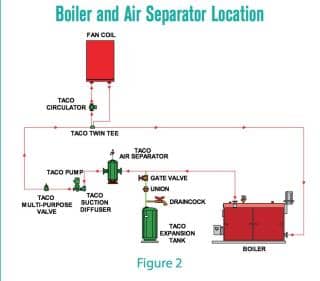
The highest temperature in a system is typically on the discharge of boilers and inlet of chillers. Therefore, the general rule of thumb in hydronic systems is that Air separators should be located downstream of boilers (Figure 2) and upstream of chillers (Figure 3).
The lowest pressure in a system is typically at the expansion tank, since this is the point of no pressure change and the location of the fill valve. Therefore, the general rule of thumb in hydronic systems is that Air separators should be located at the expansion tank connection to the system.
If a conventional (non-bladder) style expansion tank is used, it is desirable to redirect the separated air to the space above the water level in the expansion tank (Figure 4).
The dotted line from the air separator (scoop) to the plain steel tank shows the proper connection, with the air piped from the scoop to the expansion tank through a special tank fitting
If a Captive Air or Bladder Style expansion tank is used, there is no reason to sav the separated air (Figure 6). Therefore, if an air separator (scoop) is used in an air elimination system rather than an air control system, the separator is fitted with an automatic air vent (Taco Hy-Vent series), which discharges the separated air to the atmosphere.
Note that since the air is eliminated through an air vent this system is called an system.
Taco Air scoops are applied in residential and light commercial applications for the removal of free air in water or water/glycol systems. The body of each air scoop provides an increased cross sectional area and lower velocity within the piping network thereby allowing free air to rise due to buoyant force.
To assist with the removal of smaller air bubbles integral baffles are incorporated within most air scoops. Air scoops are installed in conjunction with an expansion tank and air vent as shown in figure 7.
[shown below]
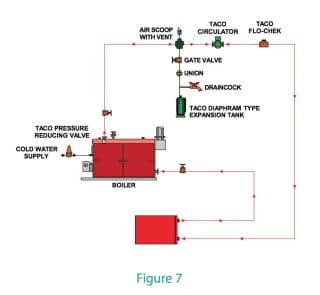
- Taco AIR ELIMINATION from HYDRONIC HEATING SYSTEMS [PDF], TACO, INC., 1160 Cranston Street, Cranston, RI 02920 USA Tel: (401) 942-8000, or TACO (Canada), Ltd., 6180 Ordan Drive, Mississauga, Ontario L5T 2B3 Canada, Tel: 905/564-9422, retrieved 2017/07/15, original source https://www.taco-hvac.com/uploads/FileLibrary/AirElimination.pdf
- TACO 4900 Air Separators INSTRUCTION SHEET [PDF] (2010) at Lowes building supplies. op. cit.
- TACO 4900 Series Air Separators, Air & Dirt Separatiors INSTALLATION OPERATION & MAINTENANCE MANUAL [PDF] (2003)
- TACO AIR SCOOP SUBMITTAL DATA / SPECIFICATIONS [PDF] (2007)
Excerpt:The air reaching the top of the air scoop is either immediately vented through a Hy-Vent or it moves into a conventional plain steel expansion tank (Taco Air Scoop models 433, 434, 435, 436, and 437), if used.
Should the air completely fill the plain steel tank and back down into the Air Scoop, the excess will be removed by the Hy-Vent without disturbing the operation of the system.
- WATTS SERIES AS AIR SCOOP (Air Separator) Specifications [PDF] (2001) Watts Regulator Co.,
USA: Watts, 815 Chestnut St. No. Andover MA 01845-6098, Website: www.wattsreg.com
Canada: Watts, 5435 North Service Rd., Burlington ONT L7L 5H7 Canada Website: www.wattscda.com
Reader Q&A - also see the FAQs series linked-to below
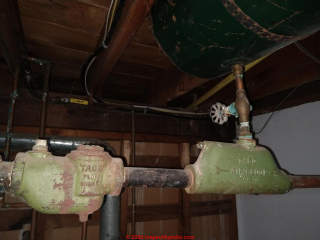 Turp
Turp
No do not fill the expansion tank with water. At service time the Expansion tank is normally drained so that air in the tank can absorb the pressure increase in the system when it heats up
. If you fill the expansion tank with water you will cause over pressure and dumping at the pressure relief valve. That would be unsafe.
It's possible that you are boiler has a scale problem. Ask your heating person about draining and cleaning and inspecting the boiler and let me know what you're told.
Hello,
My forced hot water system is very loud. The noises include banging, bubbling and rattling. I've attached a picture of the arrangement. Should the expansion tank fill with water?
Thank you
You're on track, Brian but here are a couple of suggestions:
1. that tapping on top of your air scoop is the place where you can install an automatic air bleeder - probably that'd help you out
2. trying to purge air when the system is COLD will not work and in fact can make matters worse since when you open air vents high on the system piping you may let air in rather than out.
The system needs to be hot - at full operating temperature when opening radiator vents or baseboard vents.
Which is why you take care to not get shot with hot water when operating those controls.
Conversely, to install an automatic float valve or float vent at the air scoop tapping, you need to work when the system is COLD
And as there's probably no shutoff to isolate that air scoop, you either need to know how to work on the system live with water squirting all over the place or you need to get a trained service tech to help you out.
At AIR ELIMINATOR / FLOAT VENT REPLACEMENT
you can see an example of that procedure where I replaced a leaky clogged air eliminator (float vent) on a heating convector. I let the system cool so as not to get burned and I had to be prepared for the water spray - the alternative is a lot more work to drain down the system and then re-fill it.
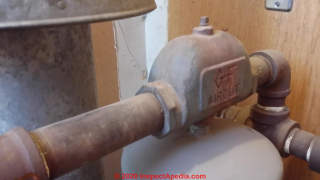 I'VE tried purging the air from all bleeders on base boards, nothing but water comes out,
I've connected hoses to boiler drain , closed isolation valves to zone lines and tried purging with auto fill water supply, normal and back flush.
I've tried isolating the boiler- draining water from zones at return line into a bucket ,and using a transfer pump from bucket back to
Zone line to purge the air, in the affected zone
Finaly replaced the circulator pump with new 3 speed ! Not the problem ,
Then I connected a garden hose (after letting boiler cool off all day ) to try and get more pressure to move air block NOTHING HAS WORKED.
The highest point for air to trap (Single story home-boiler in closet outside) is this air scoop ,with no bleeder just a plug.
I will put a TACO auto bleeder in if I can take this plug out without screwing something up.,
So with boiler shut down ( cooled to atmospheric temperature )
can I then turn on circulator pump and crack this plug until water comes out ,
or will it let preload pressure out of my expansion tank ?
Worried since the tank doesn't have a valve to recharge air pressure.
I'm sorry for rambling on, just going crazy with what should be a simple PURGE. THANKS IN ADVANCE.
Brian:
I cannot find the "GF AIROUT scoop" to see its product details. Please attach a photo using the add image button.
One of the good places but not the only place for an air vent is atop the air scoop - that's why there's usually a tapping that permits adding a vent there if one was not already installed.
Watch out: I do not recommend loosening a plug to try to manually release air at the air scoop, as you're likely to get scalded with hot nasty heating water.
My GF AIROUT Scoop doesn't have an auto bleeder installed on top !
It just has a plug where the bleeder should be ,If I cool the system down
Then turn on the circulator, can I then crack this plug to bleed out the air ?
It has a bladder expansion tank mounted below the air scoop that has no Schrader valve .
So not having a Schematic of how the scoop works, I don't want to open this plug and screw things up
With the expansion tank ,Thanks for any advice.
...
Continue reading at AIR-BOUND HEATING SYSTEMS or select a topic from the closely-related articles below, or see the complete ARTICLE INDEX.
Or see AIR SCOOPS SEPARATORS PURGER FAQs - questions & answers posted originally at this page.
Or see these
Recommended Articles
- AIR-BOUND HEATING SYSTEMS - home
- AIR BLEEDER VALVES
- AIR BLEEDER VALVE FUNCTIONS
- AIR BLEED VALVE INSTALLATION
- AIR BLEED VALVE LEAK REPAIR
- AIR BLEED VALVE SOURCES
- AIR ELIMINATOR / FLOAT VENT REPLACEMENT
- AIRBOUND RADIANT HEAT
- AIRBOUND HEAT SYSTEM REPAIR by PUMP
- AIRBOUND HEAT SYSTEM REPAIR by WATER FEED VALVE
- AIR SCOOPS PURGERS SEPARATORS
- DISSOLVED OXYGEN DAMAGE CONTROL - use of bulk air eliminators on hydronic heating systems helps avoid damage from dissolved oxygen
- RADIATOR PLUG REMOVAL
- RADIATOR VALVES & HEAT CONTROLS
Suggested citation for this web page
AIR SCOOPS SEPARATORS PURGERS at InspectApedia.com - online encyclopedia of building & environmental inspection, testing, diagnosis, repair, & problem prevention advice.
Or see this
INDEX to RELATED ARTICLES: ARTICLE INDEX to HEATING RADIATORS
Or use the SEARCH BOX found below to Ask a Question or Search InspectApedia
...
Ask a Question or Search InspectApedia
Try the search box just below, or if you prefer, post a question or comment in the Comments box below and we will respond promptly.
Search the InspectApedia website
Note: appearance of your Comment below may be delayed: if your comment contains an image, web link, or text that looks to the software as if it might be a web link, your posting will appear after it has been approved by a moderator. Apologies for the delay. Our Comment Box is provided by Countable Web Productions countable.ca
Technical Reviewers & References
Click to Show or Hide Citations & References
Source: https://inspectapedia.com/heat/Air_Separators_Scoops.php

Enregistrer un commentaire for "Micro Bubble Air Separator for Steam Boiler Water Feed"